Comparisons
Expense Tracker or Bill Splitter: Which Telegram Bot Does Your Group Need?
Read in other languages: Русский
An expense tracker shows where your own money goes: categories, budgets, a monthly report. A bill splitter is for money several people spend together, and it answers one question: who owes whom, and how much. If the money is all yours, get a tracker. If a second person with their own card is part of the story, you need a bill splitter. SplitFast is the second kind, and below is an honest look at where it won’t help.
One name, two different tools
People say “expense tracker” about two separate jobs. One is about a single person: you log a $5.50 latte under Coffee, and at the end of the month you open a pie chart and sigh. The other is about a group. Ben paid for the apartment, Chloe got dinner, Sam covered the rides, and somebody has to turn all of that into one number per person.
The jobs differ, so comparing the two on a single feature list makes little sense. A bill splitter loses to any tracker on categories. The tracker loses on debts.
| Personal tracker | Bill splitter | |
|---|---|---|
| Whose money | Yours | Shared: one person pays, several benefit |
| The question | Where did my money go this month? | Who owes whom? |
| Who logs | You | Anyone in the group |
| What you get | Spending by category, budget left | Balances and a list of transfers |
| Categories and budgets | Yes, that’s the whole point | Usually none |
| Debts between people | None, or by hand | Worked out for you |
Case one: your own budget
Megan is 27. Payday is the 1st, and by the 20th her account is nearly empty, every month. She decides to find out why and logs everything: a $5.50 coffee on the way to work, an $18 ride home, $32 of takeout. A month in, she sees $210 went on rides. Takeout was worse.
There is nobody to split with, so a bill splitter does nothing for her. In a group of one, nobody owes anybody. Megan needs a personal tracker: a budgeting app, a spreadsheet, or a tracker bot in Telegram where she can drop expenses on the go. If nearly everything goes on a card, check your bank’s app first. It may already sort your spending by category.
Case two: a couple
Emma and Josh moved in together six months ago. Emma pays the $1,800 rent from her own account. Josh covers groceries, utilities and household stuff, which came to $1,160 in October. They agreed to split everything down the middle.
Which tool a couple needs depends on how they run their money. If both paychecks land in a joint account and everything is paid from there, that is one budget for two, and a shared tracker with categories fits. For that setup, see the guide to tracking family expenses in Telegram.
Emma and Josh keep separate cards, so their monthly question is a different one: who tops up whom. October cost them $2,960, or $1,480 each. Emma paid $320 more than her half and Josh $320 less, so one transfer from Josh closes the month. Emma’s personal tracker, meanwhile, just shows $1,800 under Housing, with no sign that $320 of it is coming back.
With different incomes there is no rule that says 50/50. Agree on 60/40 and a bill splitter works out the shares. More on that in splitting a bill unequally.
Case three: a weekend for four
Ben, Chloe, Sam and Nina are spending a weekend in Austin. Ben books an apartment for two nights, $720. Chloe pays for dinner the first evening, $236. Sam covers the rides to and from the airport, $72. Nina buys groceries for breakfast, $112.
Say each of them keeps a personal tracker. Ben’s now shows $720 under Travel, though $540 of that is his friends’ share. Nina’s shows $112, while the trip actually cost her $285. When the others pay Ben back, those transfers have to go somewhere in his tracker without turning into income. And none of the four apps can tell them who owes whom.
A bill splitter puts every expense in one place. The weekend cost $1,140, so each share is $285.
| Paid | Share | Balance | |
|---|---|---|---|
| Ben | 720 | 285 | +435 |
| Chloe | 236 | 285 | −49 |
| Sam | 72 | 285 | −213 |
| Nina | 112 | 285 | −173 |
Three transfers, all to Ben: Chloe $49, Sam $213, Nina $173. Had Nina arrived a day late, her share of the rent could have been cut and everyone else’s amounts would have adjusted on their own. The guide to settling group debts explains how the app gets to the fewest transfers. If your group pools cash with one person up front, the bookkeeping works differently; the shared trip fund guide covers it.
Where each tool breaks
A tracker on shared money
- Whoever paid for everyone sees inflated spending. Everyone else sees too little.
- Paybacks from friends get mixed up with income and skew the monthly report.
- Each person has their own version of events, and reconciling them happens in the group chat.
- There is nowhere to leave someone out of one expense or split a purchase by shares.
A bill splitter on a personal budget
- No categories, so it can’t tell you what you spent eating out last quarter.
- No budgets either. You can’t cap your takeout at $150 a month.
- It doesn’t pull in bank transactions. Everything is entered by hand.
- Your solo coffee has no business being there. The group doesn’t care about it, and it tells you nothing.
SplitFast is built exactly this way: no categories, no budgets, no bank connection and no mode for a single person. That is on purpose. It lives in a group chat and counts only what people share.
How to choose: four questions
- Is the money only yours? A personal tracker or a budgeting app.
- Do the two of you live off one joint account? A shared tracker for two.
- Do different people pay for things you all use, like a trip, a shared flat or a group gift? A bill splitter in your group chat.
- Need both? Use both. They get along fine once you agree on what goes where.
Running both without counting twice
A personal budget and group trips get along fine if you keep one rule: only your share goes into your personal tracker, and only after you settle up.
- Log shared expenses in the group, in the bill splitter. Don’t copy them into your personal tracker.
- After the trip, open balances, make the transfers and mark the debts as settled.
- Add one amount to your personal tracker: your share. For Nina that is $285 under Travel. For Ben it is also $285, even though $720 left his card.
- Money you send to or get from friends is neither income nor spending in your personal budget. If your tracker imports bank transactions, exclude those transfers or mark them as transfers.
What SplitFast is for
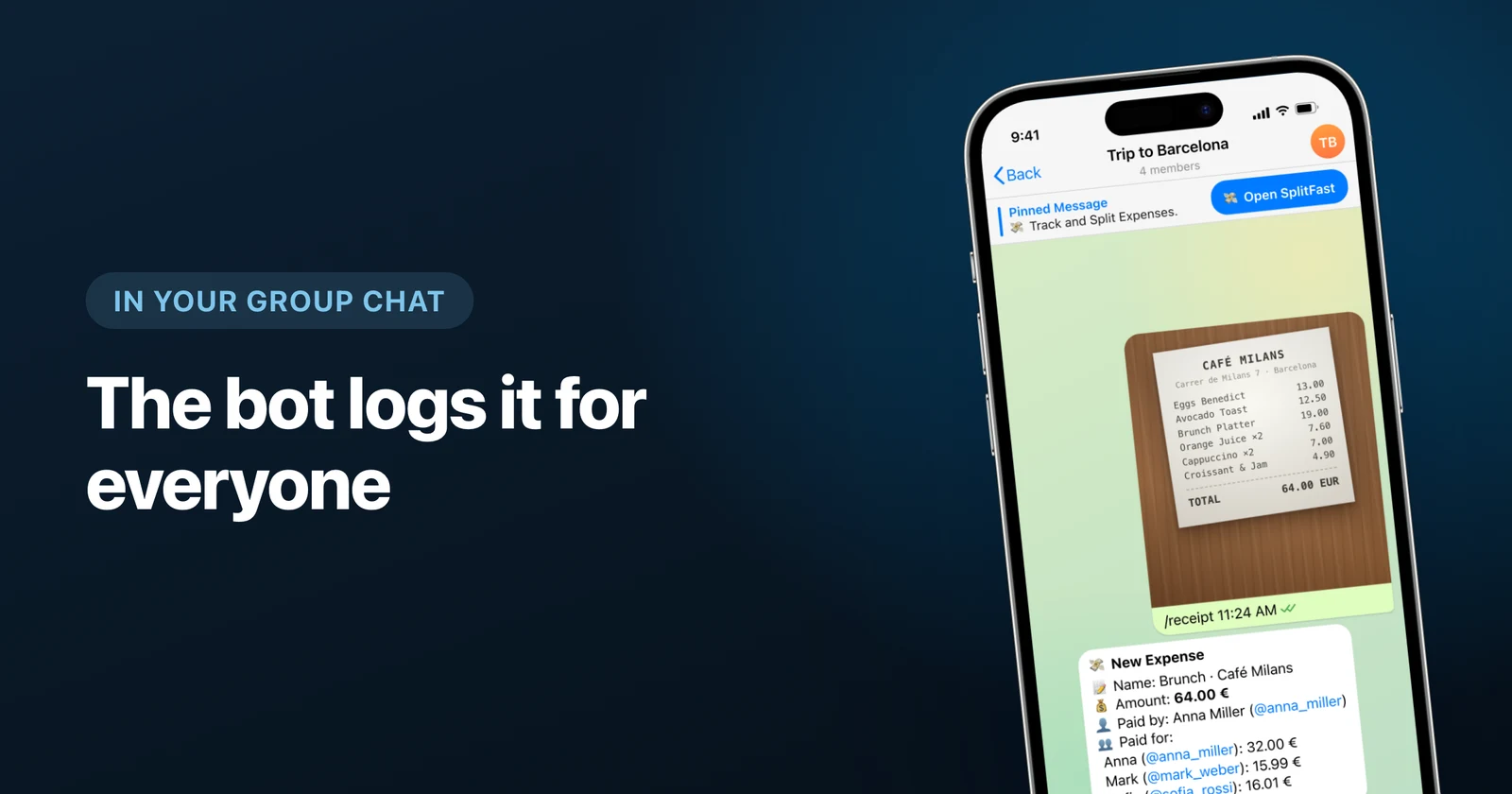
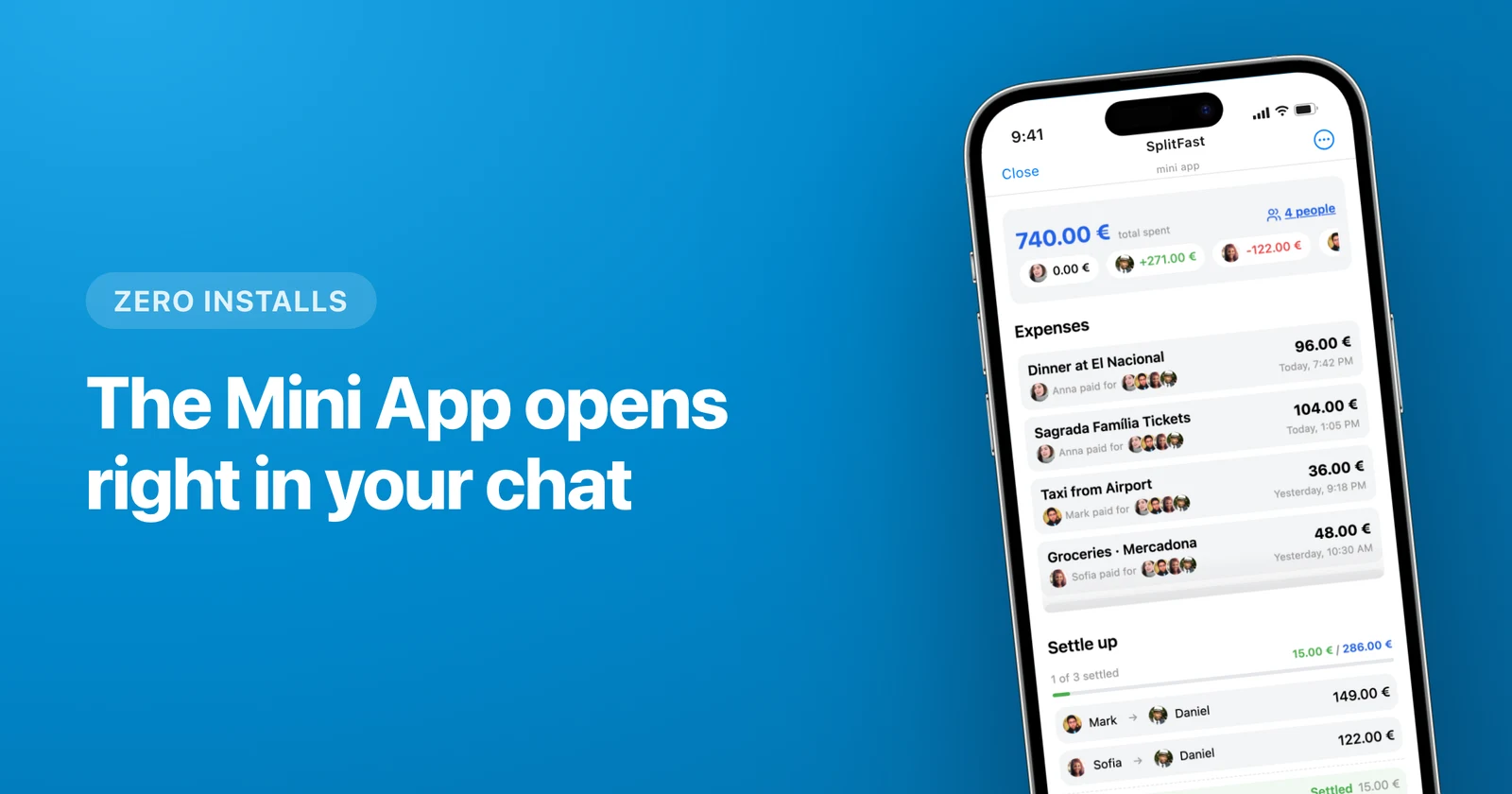
SplitFast lets you split expenses in Telegram right inside your group chat. Add @SplitFastBot to the group and members show up on their own. Nobody signs up or installs a separate app: the Mini App opens inside Telegram on iOS, Android, desktop and the web.
- Anyone in the group logs an expense: who paid, how much, who shares it.
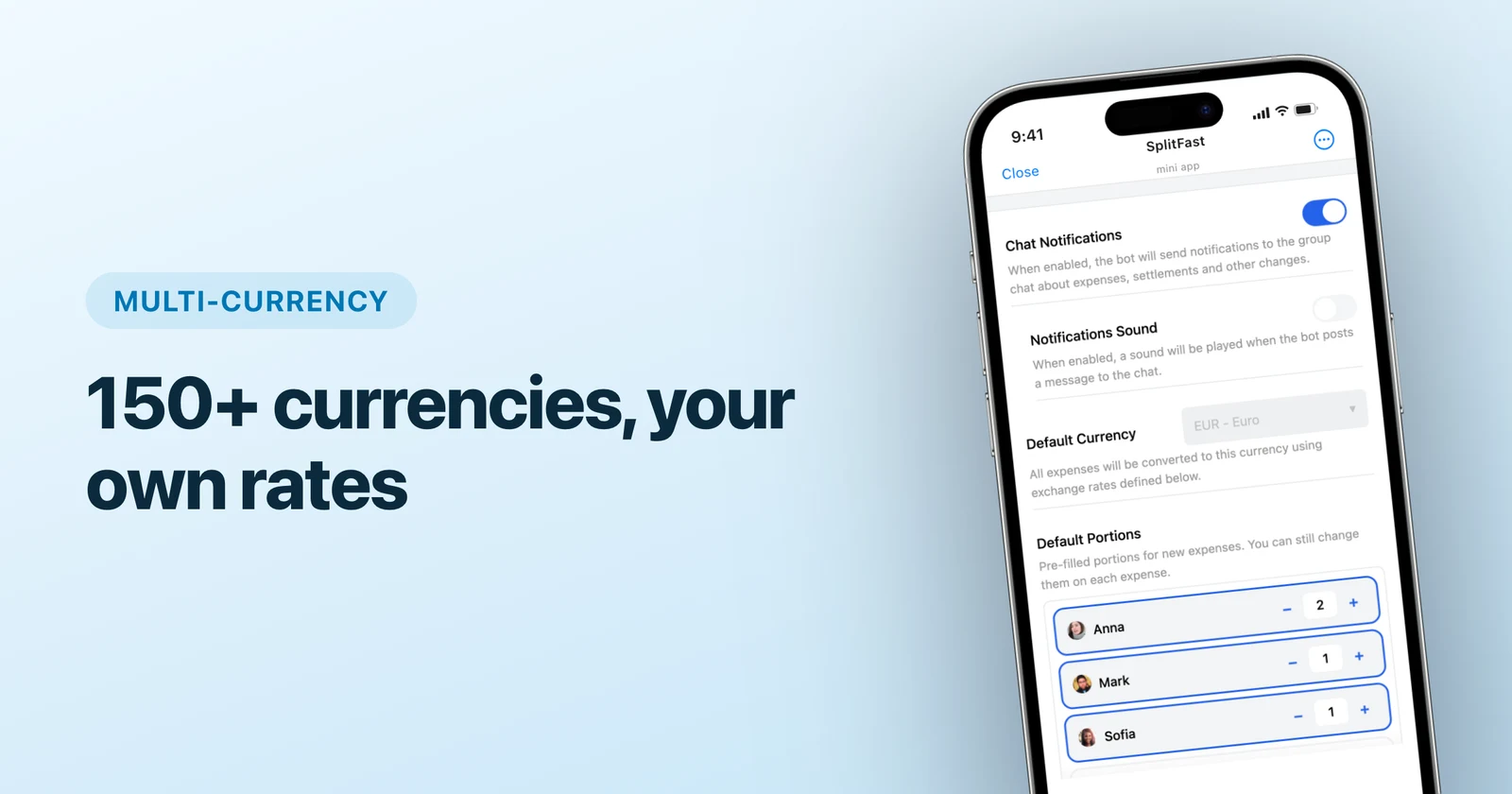
- Split equally, by portions (2:1, or 0 to leave someone out of an expense) or by exact amounts. Default portions are set once for the group.
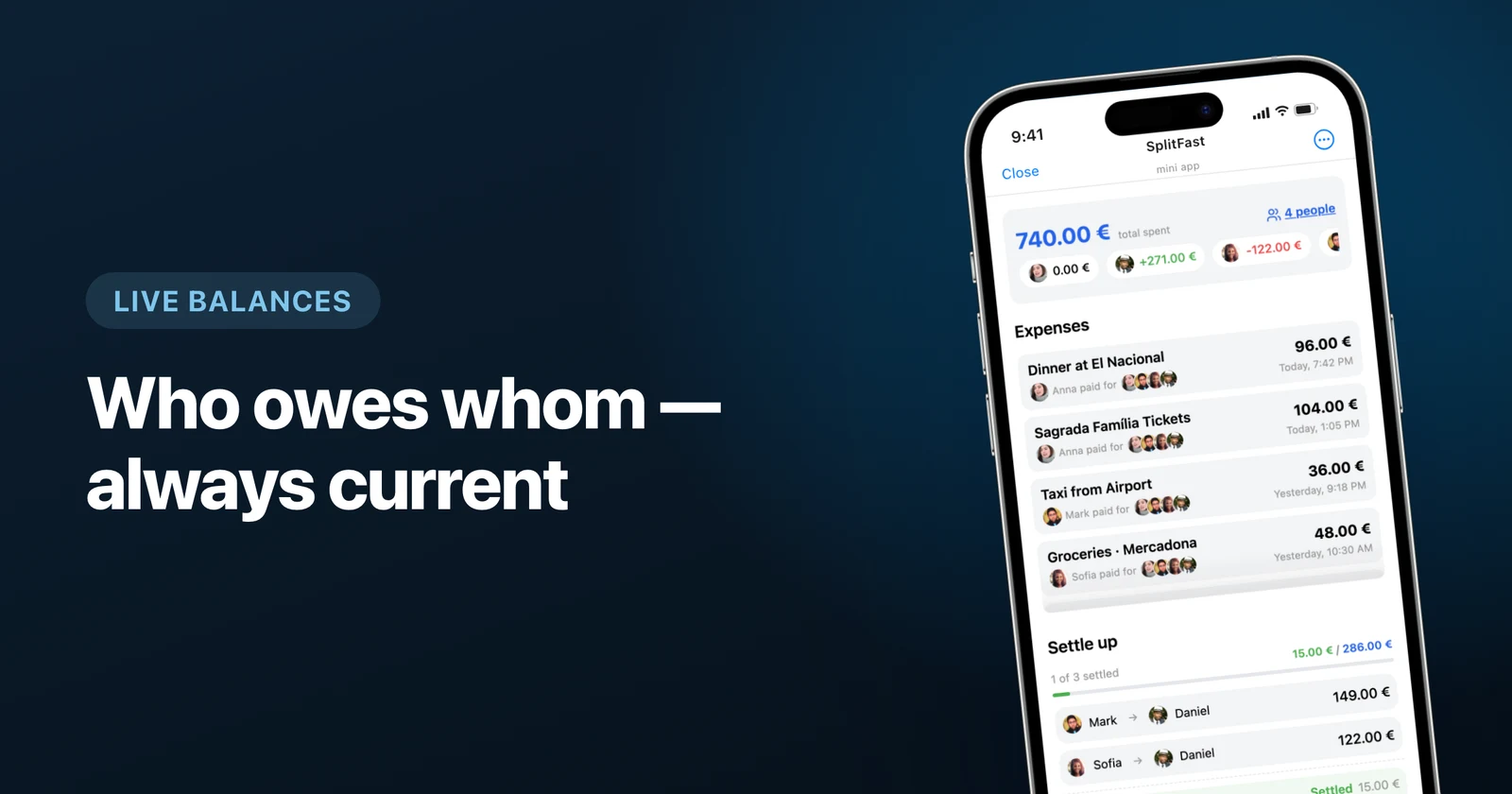
- Balances update as you go, and debts are reduced to the fewest transfers. When you settle up you see where to send the money, and you mark the debt as paid in the app.
- A friend who isn’t on Telegram can be added by name.
- The interface comes in seven languages, and each member picks their own.
Comparing bots for shared expenses? Our roundup of the best Telegram bots to split expenses goes through the options. And the step-by-step guide takes you from the first expense to the last transfer.
Frequently asked questions
Can I use SplitFast as a personal budget app?
No. SplitFast has no categories, no budgets, no bank connection and no mode for one person. It works inside a Telegram group chat and keeps track of shared spending: who paid, who shares each expense and who owes whom. For your own finances, use a personal tracker or a budgeting app.
What is the difference between an expense tracker and a bill splitter?
An expense tracker records one person’s spending by category and shows where the money went each month. A bill splitter works for a group: everyone logs what they paid, and the app keeps the balances and tells each person who to pay and how much.
Which one should a couple use?
If you share one account and pay for everything from it, you have one budget, and a shared tracker with categories fits. If you keep separate cards and each of you pays for different things, the question is who owes whom, and a bill splitter handles that better. Plenty of couples use both.
How do I record a group trip in my personal budget?
Log the shared expenses in the group’s bill splitter, settle up after the trip, then add a single entry for your share to your personal tracker. Transfers to and from friends count as neither income nor spending in your own budget.
Does everyone in the group need to install an app?
No. SplitFast runs as a Mini App inside Telegram. You add the bot to the group, members are picked up automatically and nobody has to register. Friends who aren’t on Telegram can be added by name.