Travel
The Shared Trip Fund: How to Record the Kitty So Balances Stay Honest
Read in other languages: Русский·简体中文·Bahasa Melayu·தமிழ்
Money you hand to the person holding the trip kitty is a payment between people. Only what comes out of that kitty belongs in the expense list: the house, the groceries, the fuel. Log the contribution itself as an expense and the app gets it wrong by exactly two contributions.
A familiar scene
A week before departure, someone posts in the group chat: “send Kirill €150 each, he books the house and does the shopping.” Four people, €150 apiece, €600 sitting on Kirill’s card. Then three days in the mountains where nobody opens a calculator.
Sunday evening Anna opens the app and reads that she still owes Kirill €290. She paid ten days ago and has not spent a cent since. Kirill is convinced he kept the books properly, and technically he did: every purchase went in the same day it happened.
Twenty minutes of chat follow.
The numbers we keep for the whole article
- Kirill, Anna, Mark and Sofia. Everyone gave Kirill €150, so the kitty holds €600.
- Paid out of it: house €320, groceries €180, fuel €60. Total €560.
- Unspent: €40.
The honest outcome: each person’s share is €140. Kirill hands €10 back to each of them and keeps €10 himself. Trip closed, everyone at zero.
What breaks when a contribution is logged as an expense
The reasoning is tempting: money left the card, so it must be an expense. A record appears — “Trip fund, €600, paid by Kirill, split equally four ways.” The app does precisely what it was told and charges everyone €150 owed to Kirill.
Then Kirill dutifully logs the real purchases, €560 worth. That is another €140 per head.
Anna sees €290 of debt in a place where she is owed €10.
| Kitty logged as an expense | Kitty logged as a payment | |
|---|---|---|
| Group “total spent” | €1,160 | €560 |
| Anna’s balance | owes Kirill €290 | Kirill owes her €10 |
| Gap with reality | €300 per person | 0 |
That €300 comes from something simple. Anna’s contribution reduced her debt to Kirill by €150; the expense record increased it by the same €150. The sign flipped, so the error doubled. Across four people that is €900 of drift on a trip that cost €560.
The mistake is a natural one. Every expense form asks who paid and who shares it, and a kitty contribution answers cheerfully: everyone paid, split it between all of us. Except nothing was bought.
How to record it so everything adds up
Leave the kitty out of the expense list
No €600 record exists anywhere in the app. That money has not bought anything yet, it merely changed pockets.
Log the purchases
House €320, groceries €180, fuel €60, payer Kirill. Split however suits: equally, by portions, or by receipt items when everyone grabbed their own things at the supermarket.
Read the balances
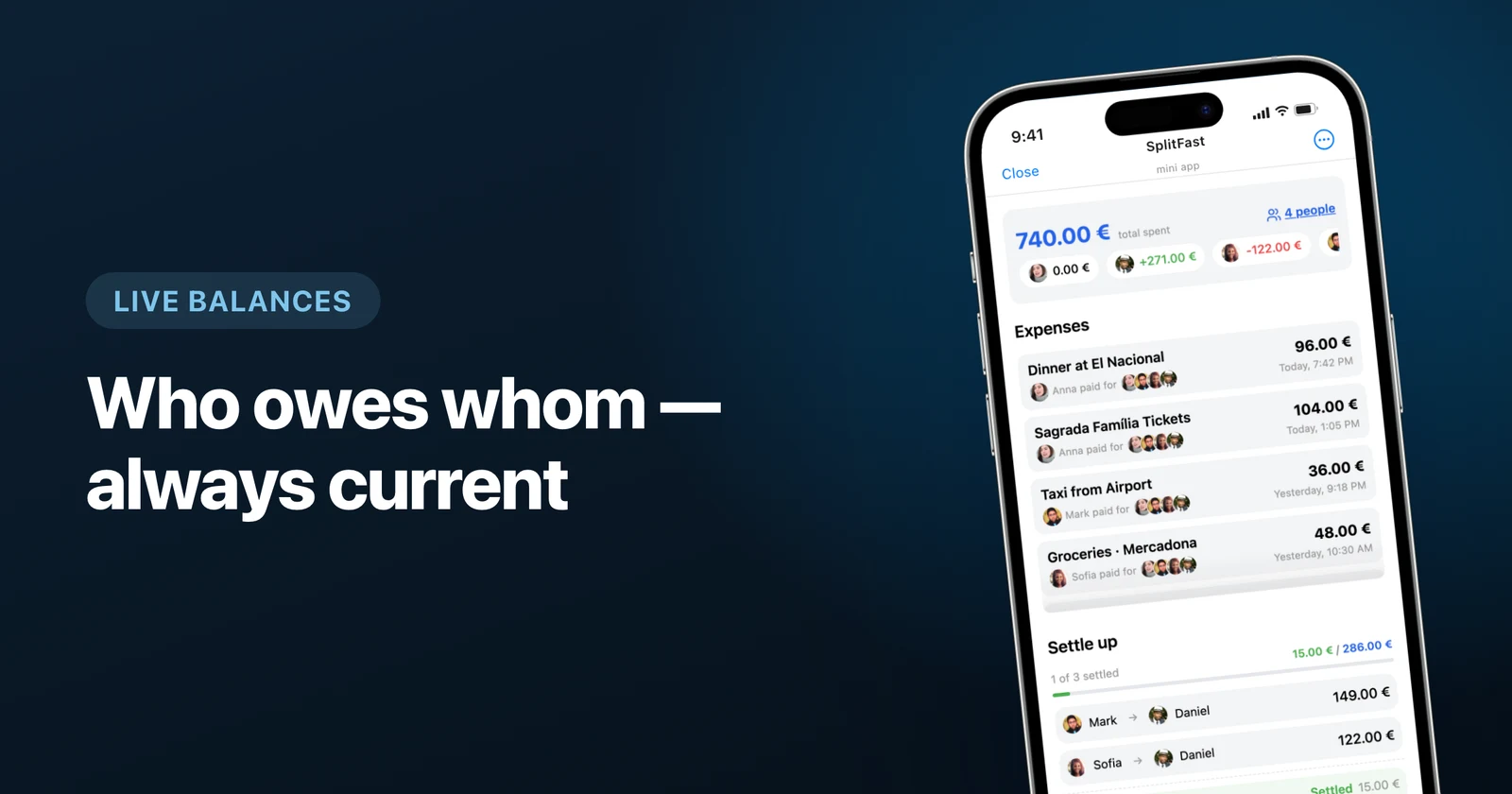
The app shows Anna, Mark and Sofia each owing Kirill €140. That is the truth about the spending. The contributions are not in that number yet.
Close the contributions as settlements
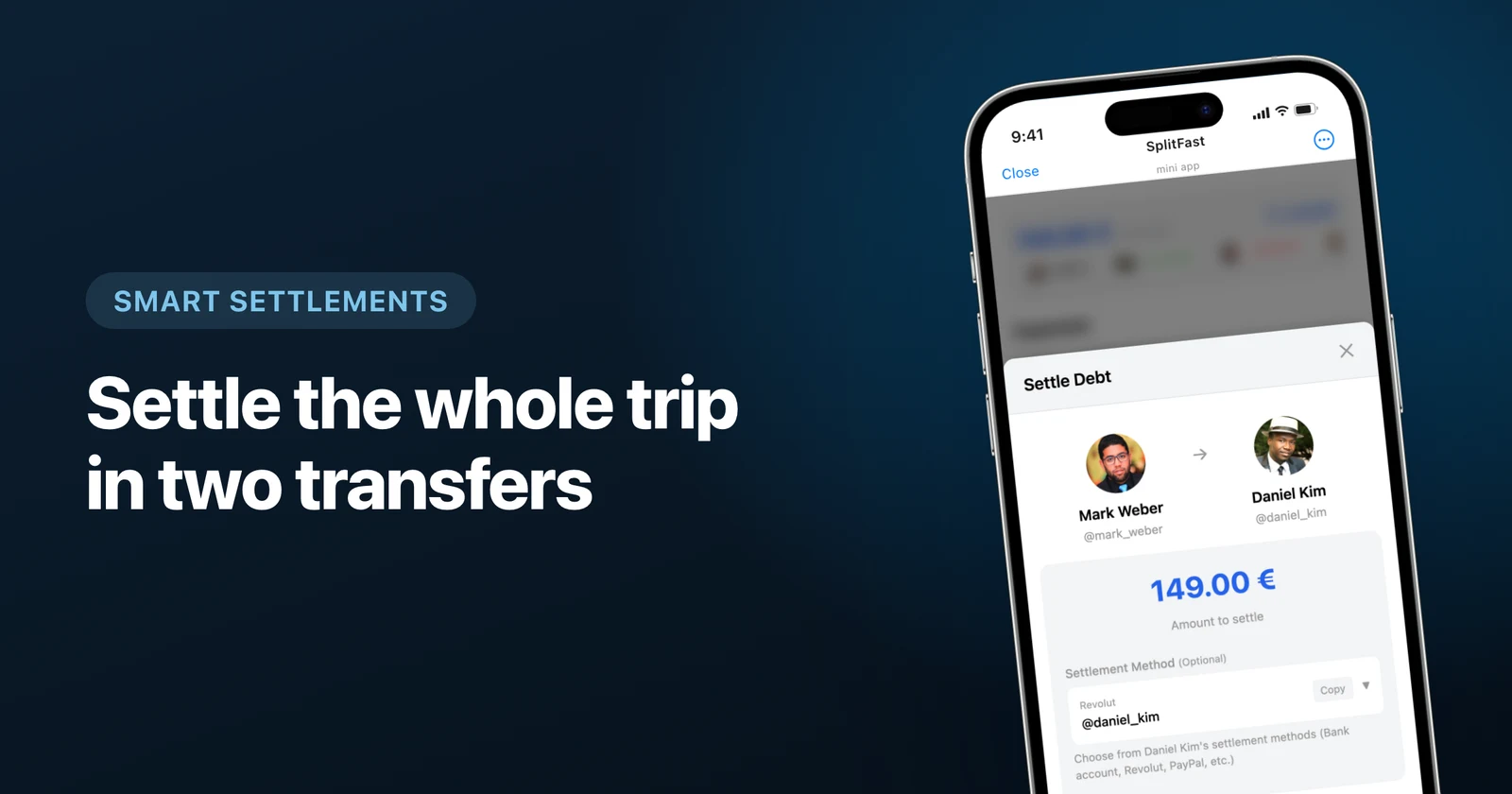
Kirill hands back €10 to each, and then every €140 debt gets marked as settled. Marking means “we are square,” so it comes after the money has actually moved.
The leftover
Those €40 are still your money, they just happen to be in Kirill’s pocket. Nothing needs splitting: no house and no fuel came out of them.
The kitty runs dry on Wednesday
Classic situation: two days left and the money is gone, so everyone tops up another €50. The rule holds. A top-up is another payment to the holder, and the expenses are whatever that €50 turns into.
Same story when someone joins the trip late and pays in on Thursday. Their contribution closes their debt, and their share is worked out from the expenses they were actually part of. Nothing needs recalculating by hand.
How to tell your balance is already lying
A two-minute check. Add up the receipts you actually have and compare that with the group total in the app. If the difference is a suspiciously round number that looks a lot like the contributions, open the expense list and look for a record called something like “fund”, “kitty” or “shared”.
Second symptom: everyone owes one person amounts that nobody can tie to a specific purchase. The cure is deleting that record. Balances recompute on their own and only the real spending is left.
When someone else spends the fund money
Kirill hands Mark €100 in cash for dinner. Same rule applies. Dinner goes down as an expense paid by Mark, because Mark is the one who paid at the till. The €100 that moved between them lives in settlements as a payment from Kirill to Mark. It was never an expense for a single second.
Which suggests a good habit: one person holds the kitty. Once cash gets handed around to everybody mid-trip, any ledger turns into reconstructing events from memory.
Checklist before you leave
- Agree who holds the fund and name that person out loud in the chat.
- Add the bot to the trip chat before the first receipt lands in anyone’s pocket.
- The holder logs purchases the day they happen. Photographing the receipt is faster than reconstructing a supermarket bag on Sunday.
- Paid in a foreign currency? Log it as paid and let the rate do the conversion.
- At the end: hand back the difference, mark the debts settled, let the rest collapse into the fewest transfers.
A shared kitty is a genuinely good idea. One person pays for everything, nobody pulls out a card at every petrol station. It breaks in exactly one place: the moment a contribution gets dressed up as a purchase. Keep those two things in separate parts of the ledger and there will be nothing to argue about on Sunday night.
Frequently asked questions
Where do I record a contribution if nothing has been bought yet?
While the fund holder has not spent anything, no debt exists and there is nothing to mark. The money is simply sitting with them. As soon as the first purchases are logged, a debt appears in the balances, and that is what you close.
What if everyone logs their own €150 as an expense?
The balances come out exactly as if no one had contributed at all: each person still owes the holder €140. Meanwhile the trip history gains four purchases that never happened and the group total balloons from €560 to €1,160. Six months later nobody can decode that number.
Our contributions were uneven — one person put in €200, another €100.
Nothing changes. Each contribution closes the debt of the person who made it, and the holder hands back or collects the difference before the debt is marked as settled. If the shares are uneven too — someone travelling with a partner or a kid — turn on default portions and the app works out the shares itself.
Someone other than the holder spends the fund money. How is that recorded?
Same rule. Cash handed over from the kitty is a payment between two people, from the holder to whoever went shopping. The purchase itself goes on the person who paid at the till.
The fund is in one currency and we spend in another. Do balances drift?
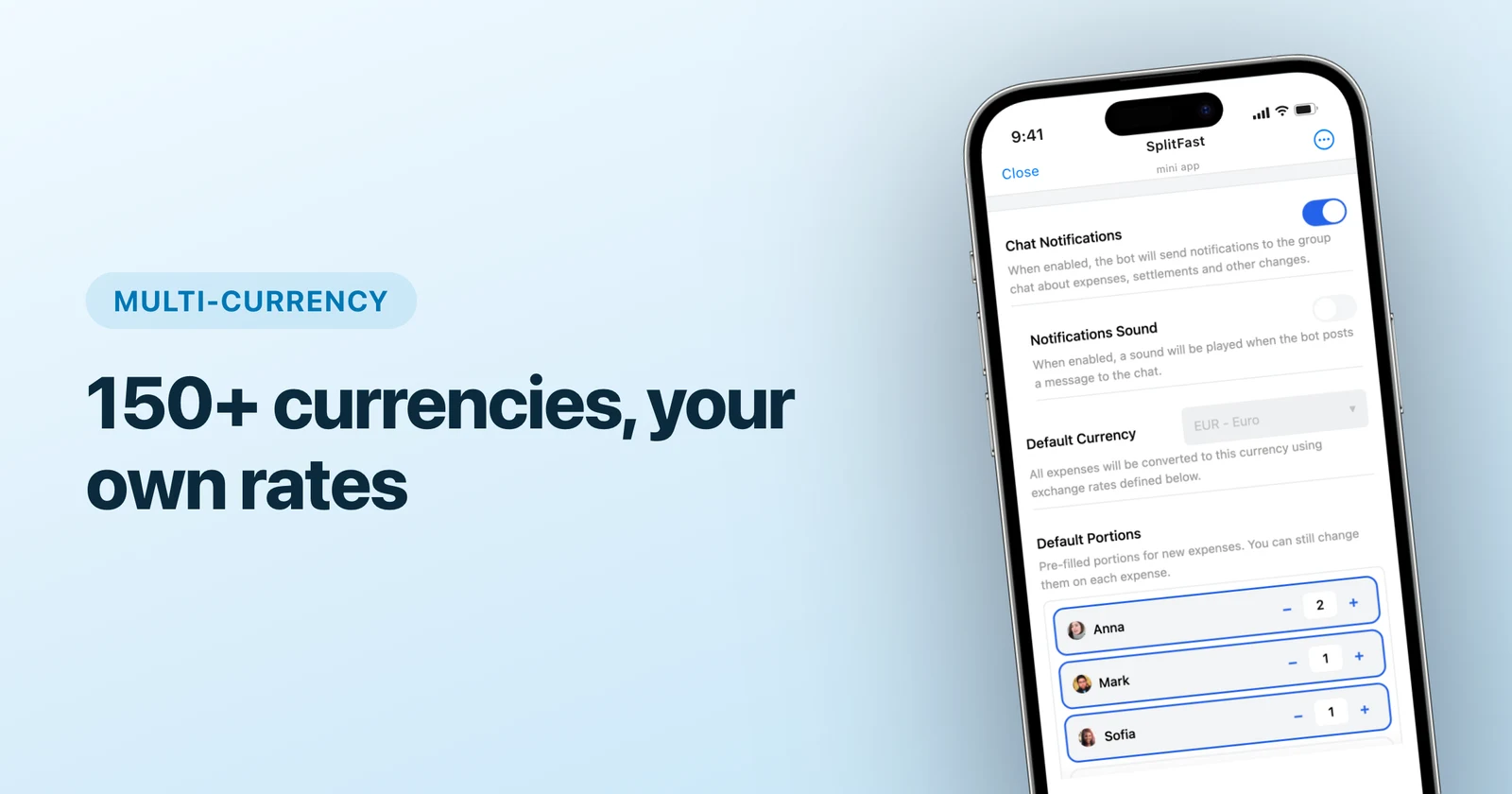
No. Log every purchase in the currency you actually paid, and balances converge in the group’s main currency. If your group agreed on its own exchange rate, pin it and all the maths follows your number.