Guides
How to Settle Group Debts Without Awkwardness: Smart Settlements Explained
Read in other languages: Русский·Українська·Беларуская·हिन्दी·Español·Bahasa Indonesia·简体中文·Bahasa Melayu·தமிழ்
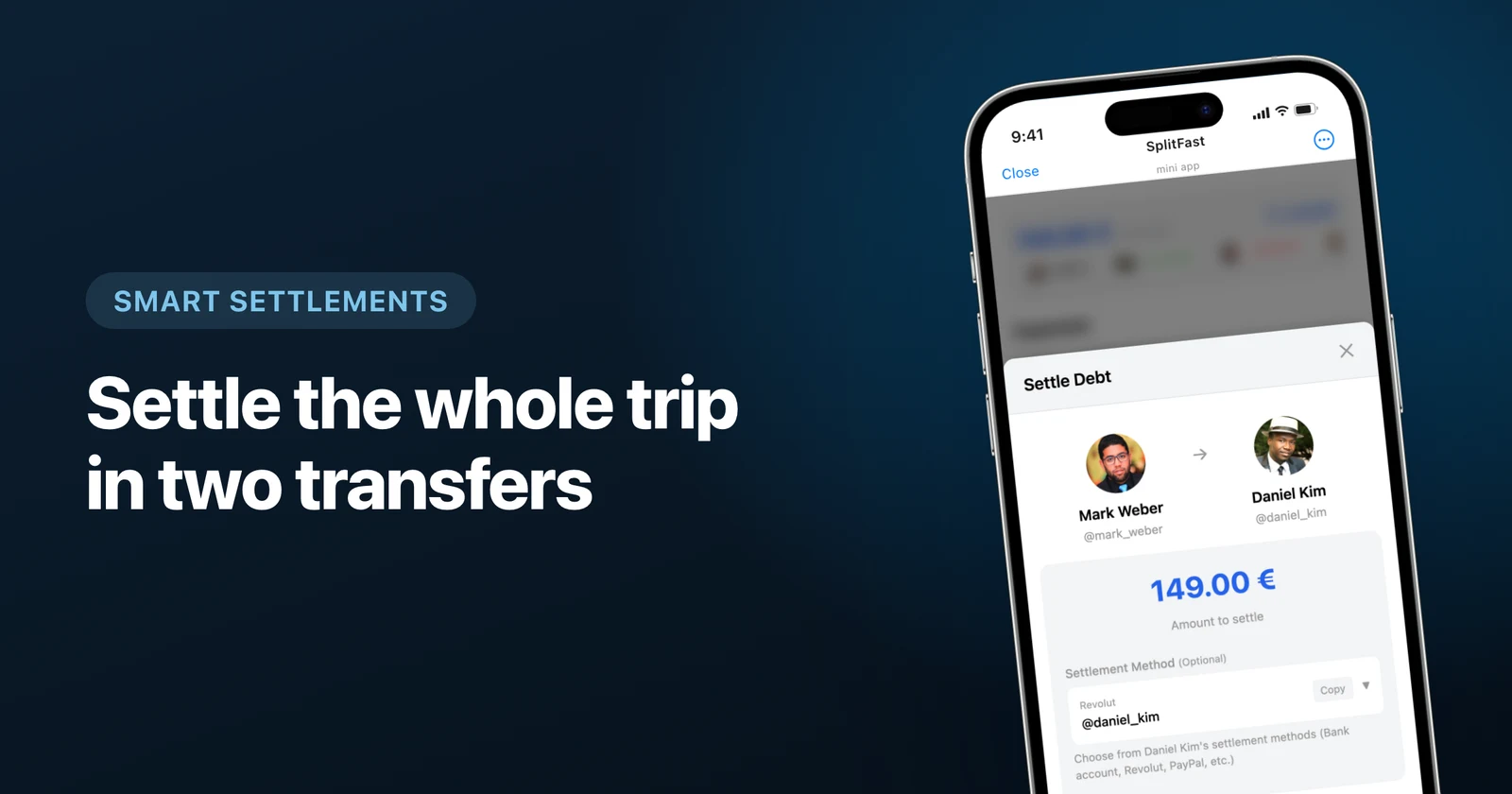
The smart way to settle group debts is to net them first: instead of everyone paying everyone, the group's debts are mathematically collapsed into the minimum number of transfers — then each payment gets made once, with the recipient's payment details one tap away. In SplitFast this whole flow lives in your Telegram group, ending trips with two transfers instead of ten Venmo-style micro-payments.
The problem: debt spaghetti
Four friends, one weekend: Anna paid the hotel, Mark paid dinners, Sofia covered the car, Daniel bought tickets. Naively, that is up to 12 pairwise debts (everyone × everyone). Every extra transfer is a small tax: someone must remember it, request it, chase it, and thank for it.
Netting fixes the math. If Anna owes Mark and Mark owes Sofia, Anna can pay Sofia directly — same end state, one transfer fewer. Run that logic across the whole group and a typical trip settles in one to three transfers, total.
What "smart settlement" means in SplitFast
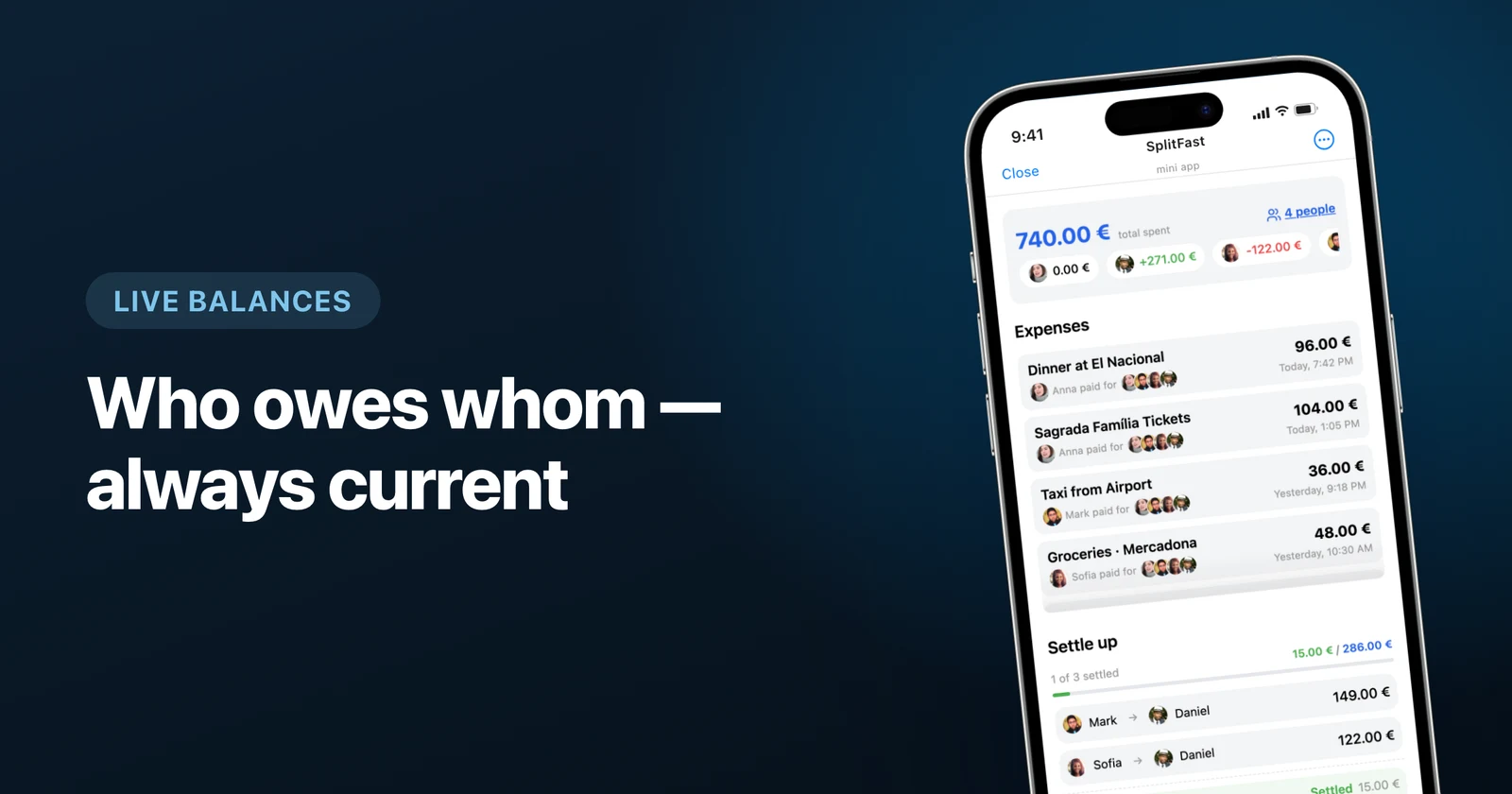
- Continuous netting. Balances are always shown pre-netted — you never see the spaghetti, only the resolved picture.
- Minimum transfers. The suggested payments are the fewest that zero the group out.
- Payment details attached. Members save how they like to be paid — bank, IBAN, payment app. "What's your account number" leaves the chat forever.
- One-tap closure. Paid? Mark as Settled. Everyone's balance updates; history remains auditable.
Why fewer transfers matter more than you think
| Pairwise chaos | Netted settlement | |
|---|---|---|
| Transfers after a 4-person trip | Up to 12 | 1–3 |
| Reminders needed | Many, awkward | Almost none |
| Fees / friction per transfer | Multiplied | Minimized |
| Chance someone forgets | High | Low — it's one payment |
There is also a social effect: a single "you owe Sofia 43 €" reads as arithmetic, while five small IOUs read as nagging. Groups that settle in one round stay friends with their ledger.
A clean settle-up ritual (steal this)
Freeze the ledger
Trip over? Log the last stragglers (airport snacks count), scan the final receipts.
Screenshot the balances
Not required — but posting the netted picture in the chat makes closure a group event, not a private chase.
Pay within 48 hours
Debts age badly. While the trip glow lasts, one tap shows each person exactly whom to pay and how.
Mark settled, archive mentally
Balances at zero, history preserved. The group is ready for the next adventure with no financial residue.
Edge cases, handled
Multi-currency trips: balances net in the group's main currency, so settlement is still one number per person — details in the multi-currency guide. Uneven consumption: if splits were fair at entry (by items or portions), settlement inherits that fairness automatically. Partial payments: pay what you can, the remainder stays tracked — no renegotiation.
Settling up is the moment expense tracking either pays off or embarrasses itself. Get the entry right, let the netting do the math, and the last act of every trip becomes what it should be: two taps and a thank-you emoji. Not on SplitFast yet? Set it up in a minute.
Frequently asked questions
How does debt simplification actually work?
It nets flows through shared debtors: if Anna owes Mark $20 and Mark owes Sofia $20, Anna simply pays Sofia $20 and Mark drops out of the chain. Applied across a whole group, this routinely collapses six or more pairwise debts into two or three transfers with the exact same end result.
Does the money go through SplitFast?
No — SplitFast is the ledger, not the bank. You pay each other directly (bank transfer, payment app, cash), using the payment details members attach to their profile. Then you mark the debt settled.
What if someone disputes a balance?
Every balance is backed by the full expense history: who logged what, when, how it was split, with receipt scans where used. Disputes turn into a 30-second history check instead of a memory contest.
When is the best time to settle — after every expense or at the end?
At natural checkpoints: end of the trip, end of the month for households. Constant micro-payments waste everyone’s time; letting balances net out first is exactly what smart settlement is for.