Guides
Splitting New Year’s Eve Party Groceries: A Shopping List for Eight and One $510 Receipt
Read in other languages: Русский·Українська·Беларуская·हिन्दी·Español·Bahasa Indonesia·简体中文·Bahasa Melayu·தமிழ்
The easiest way to split New Year’s Eve party groceries is as two expenses: food across everyone by portions (adult 2, child 1), and alcohol only across the people drinking it. A dish someone made at home counts as that person’s expense. Below is a shopping list for eight at average US prices and the breakdown of one $510 receipt.
December 30, Costco, two carts
The party is at Mike and Jen’s, because their place is bigger. Mike and Chris drive to Costco with the list from the group chat. An hour and a half later there are two loaded carts at the register, a receipt as long as your arm and $510 on Mike’s card.
The list covered everything except how to split it afterwards. Emily is driving and won’t drink. Dave’s son Leo is ten. Sarah promised her buffalo chicken dip. Chris is convinced half the cart is bourbon that only Kevin drinks.
Plenty of people ring in the new year this way. In an AP-NORC poll in December 2024, a majority of US adults planned to celebrate at home, nearly 2 in 10 at a friend’s or relative’s place, and just 5% at a bar, restaurant or organized event.
A shopping list for eight
Seven adults plus Leo. Here is the base of the spread at average US prices. The quantities are ours; the prices are Bureau of Labor Statistics averages for October 2026, rounded to the cent.
| What | How much | Average price | Total |
|---|---|---|---|
| Cheddar for the cheese board | 2 lb | $6.13 per lb | $12.26 |
| Ground beef for sliders | 3 lb | $6.76 per lb | $20.28 |
| Eggs for deviled eggs | 2 dozen | $2.32 a dozen | $4.64 |
| Potato chips | three 16 oz bags | $6.64 per 16 oz | $19.92 |
| Wine | 4 bottles, 3 liters | $14.05 per liter | $42.15 |
| Beer | 24 cans, 12 oz | $1.90 per 16 oz | $34.20 |
That’s $133.45, and it’s only the base. Shrimp, sparkling wine, buns, a veggie tray, dessert and mixers aren’t in the table, since we only used items with a published BLS average price. Prices at any one store differ from the national average, and warehouse pack sizes rarely match a list, so leave yourself some slack.
Who buys what
One big cart beats five small ones. Fewer duplicates, less to add up. Sometimes it still makes sense to split the shopping: let whoever knows wine buy the wine, and pick up ice and bread on the way over. The main rule is that everyone who pays logs their receipt the same day. Then nobody spends January 1 trying to remember who bought the sour cream.
One receipt: alcohol separately, the kid separately
Mike’s $510 receipt has two parts: $330 of food and $180 of alcohol. They’re easier to log as two expenses, because they split differently.
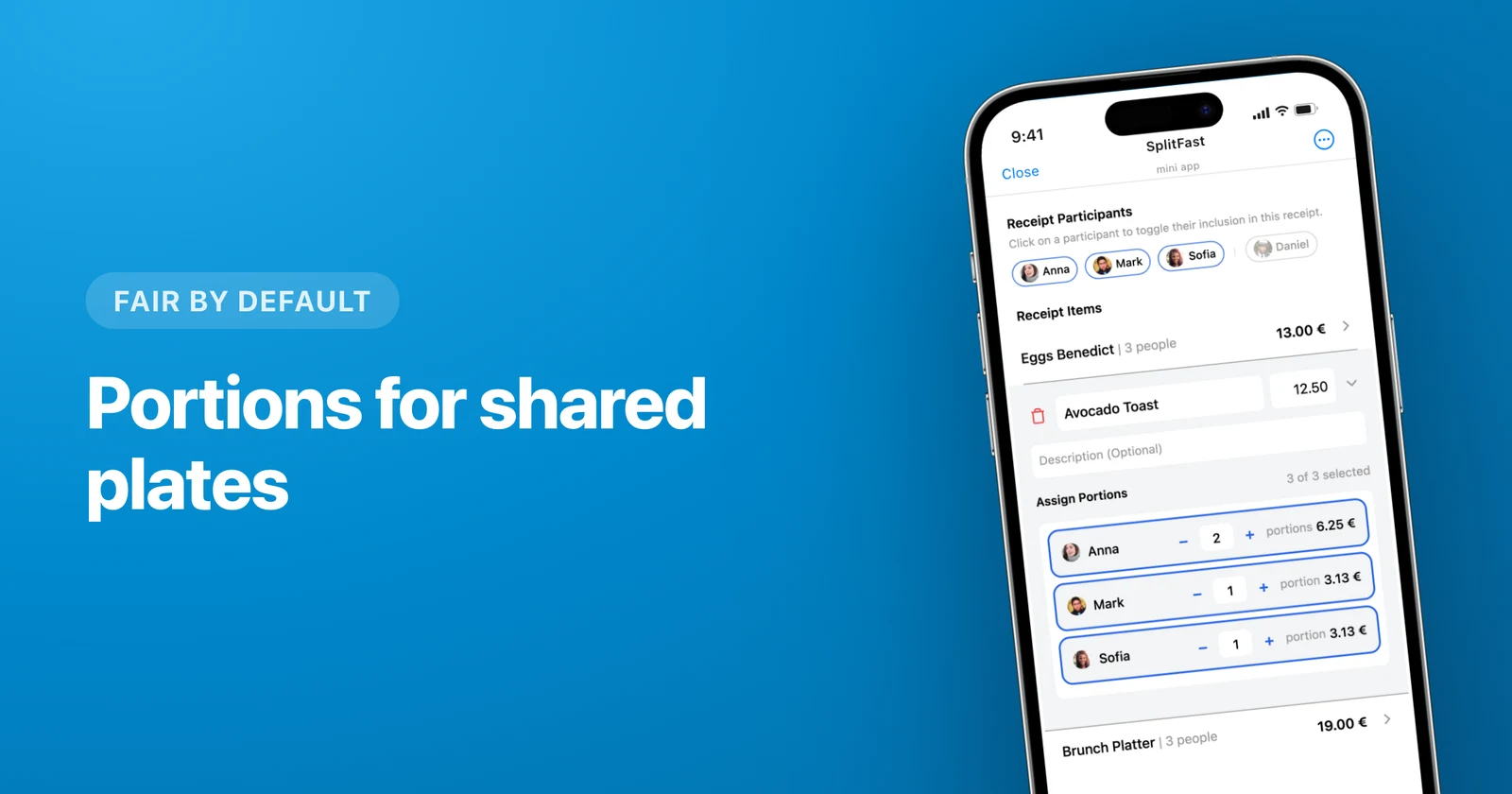
- Food is split across everyone by portions. Adults get 2, and Dave gets 3 because Leo is on his portion. That’s 15 portions at $22 each.
- Alcohol is split across the six people drinking, $30 each. Emily and Leo get 0.
The bourbon argument has the same fix. If that bottle was only for Kevin, take it out of the alcohol and log it separately, on him alone. The guide on splitting a bill unequally covers more cases like this.
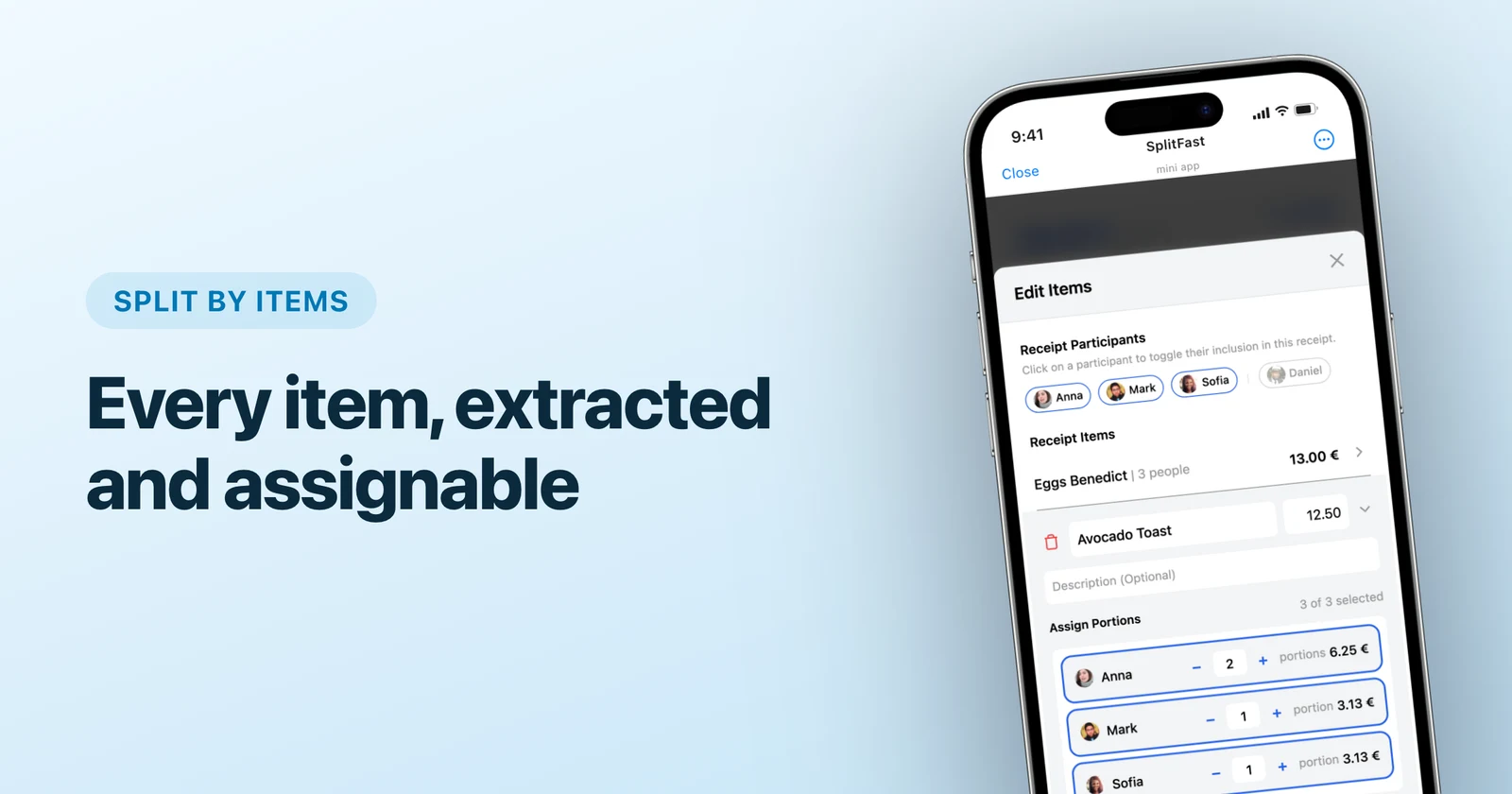
If you’d rather not work out by hand how much of the receipt was alcohol, photograph the long receipt and split it by items: each line goes to the people who ate or drank it.
The dip from home counts too
Sarah made a double batch of buffalo chicken dip for everyone and spent $30 on the ingredients. That’s as much a part of the spread as Mike’s carts. She just bought it at a different store.
Log the $30 as Sarah’s expense and split it by the same portions as the food, $2 a portion. Skip that, and Sarah pays twice: once for her dip and once more for her share of the carts.
Where everyone ends up
| Paid | Their share | Balance | |
|---|---|---|---|
| Mike (the carts) | 510 | 78 | +432 |
| Jen | 0 | 78 | −78 |
| Dave (with Leo) | 0 | 102 | −102 |
| Sarah (the dip) | 30 | 78 | −48 |
| Chris | 0 | 78 | −78 |
| Kevin | 0 | 78 | −78 |
| Emily (not drinking) | 0 | 48 | −48 |
The whole party cost $540. Everyone pays Mike, and Mike and Jen have no reason to send each other anything.
Leftovers and the unopened bottle
Leftover sliders and dip just go home in containers with whoever wants them. Nobody is going to recalculate those. An unopened bottle someone takes home is different. Say Chris leaves with a $15 bottle of sparkling wine that nobody opened. The fair move is to take it out of the shared alcohol and log it as a separate expense on Chris. Shared alcohol drops to $165, or $27.50 per drinker. What Mike paid stays the same; only the people it’s split between change.
Keeping it in Telegram
The shopping list already lives in your group chat. SplitFast lets you split expenses in Telegram right there: add the bot to the group, and the members show up in the app on their own.
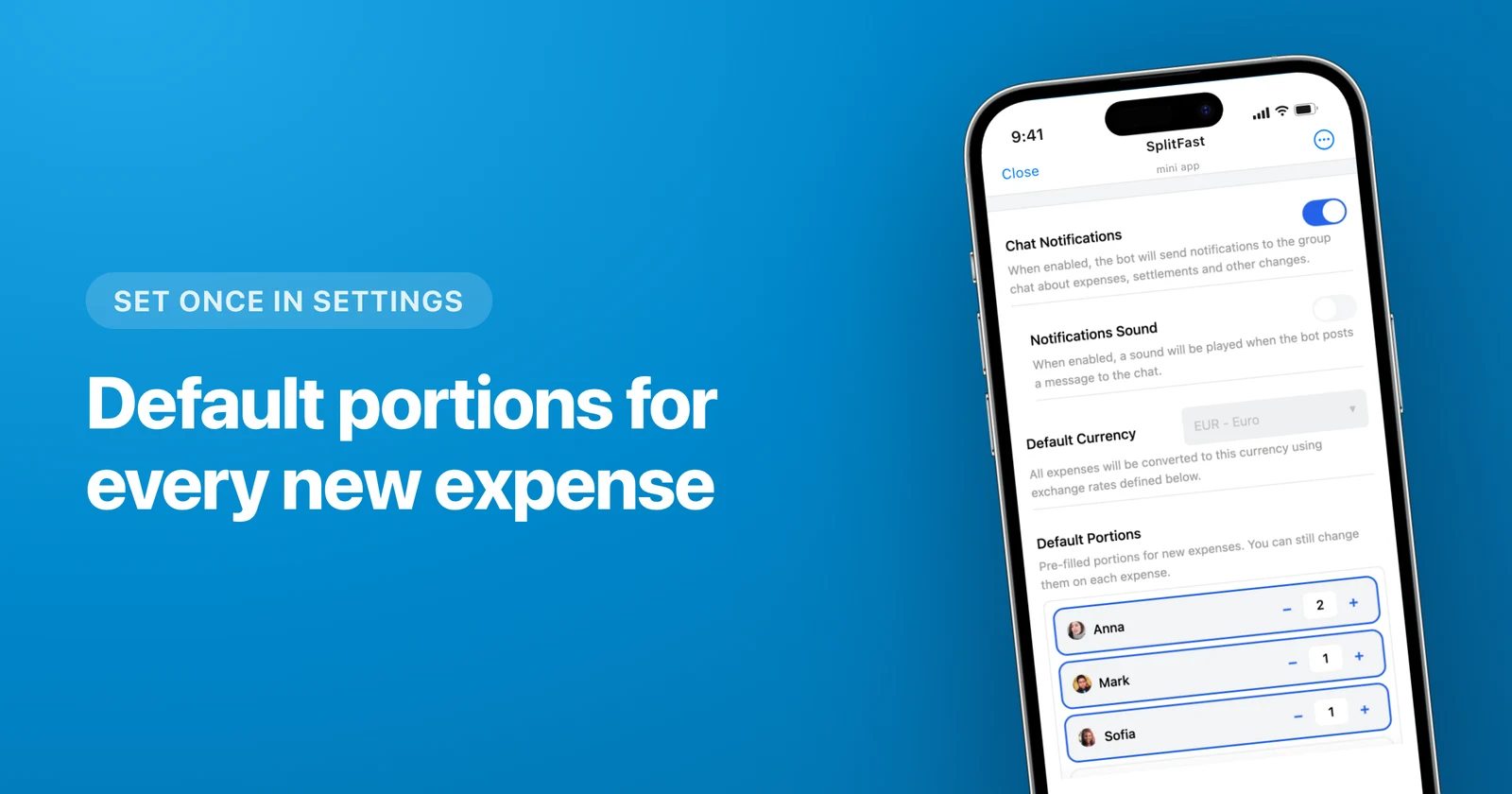
- In group settings, set “Default Portions”: 2 for each adult, 3 for Dave.
- Mike logs “Food, $330”. It splits by portions on its own.
- Mike logs “Alcohol, $180” and under “Portions” sets Emily to 0 and Dave to 2, since Leo doesn’t drink.
- Sarah logs “Buffalo chicken dip, $30”.
- Everyone sees in “Balances” how much they owe Mike. Once a payment lands, Mike taps “Mark as Settled”.
If your New Year’s is at a rented house, rent and late arrivals get added to the groceries. That’s covered in the guide on splitting a holiday house with friends.
Sources
- Average prices, US city average, October 2026 (Bureau of Labor Statistics data): cheddar, ground beef, eggs, potato chips, wine, beer (FRED, Federal Reserve Bank of St. Louis)
- Where Americans spend New Year’s Eve: AP-NORC poll, Associated Press via Indianapolis Business Journal, December 30, 2024
All links checked November 13, 2026. Prices change every month; the table uses the latest BLS figures available on that date.
Frequently asked questions
How much does a New Year’s Eve party at home cost?
There is no national figure for it. The base of our list (cheese, sliders, deviled eggs, chips, four bottles of wine and 24 beers) comes to about $133 at October 2026 BLS average prices. With shrimp, sparkling wine, dessert and everything else, the group of eight in this article spent $540.
How do we split it if someone doesn’t drink?
Split the receipt into two expenses: food across everyone, alcohol only across the people drinking. If food and alcohol are on one receipt, add up the alcohol lines and subtract them from the total.
What does a kid pay?
That’s up to the group. A handy scheme is adult 2 portions, child 1. The child’s portion goes on one parent, and on the alcohol the child counts as 0.
Someone brought a dish from home. Does it count?
It does. The ingredients cost money; they just weren’t in the shared cart. Log them as an expense paid by whoever made the dish and split it by the same portions as the rest of the food.