Travel
New Year in Georgia With Friends: Cash, Exchange Rates and Who Owes Whom in Lari
Read in other languages: Русский·Українська·Беларуская·हिन्दी·Español·Bahasa Indonesia·简体中文·Bahasa Melayu·தமிழ்
If your group is seeing in the New Year in Georgia, log every shared expense in lari, exactly as it was paid, and treat the rate each person got for their pounds as their own business. Then different exchange rates stop being something to argue about. Below: what to bring, where to change money, what a day in Gudauri costs and how to settle up at the end.
30 December, Tbilisi, four people and four kinds of lari
Four friends from London, a flat in Sololaki for five nights. Ben brought pounds in cash and changed them at an exchange office on Rustaveli Avenue. Vicky changed hers at the counter of a bank branch next to the flat. Hannah has a card with no overseas fees and takes lari out of cash machines as she goes. Tom changed nothing and says he’ll “sort it out later”. At the airport he did take some cash out on his high-street debit card, and he pressed yes when the screen offered to charge him in pounds.
By day three it turns out everyone’s lari cost something different. Vicky reckons the 240 lari of groceries cost her more than anyone else, because her lari were the expensive ones. Ben is sure he overpaid the most when he covered the 480-lari dinner. Both have a point. That’s why the argument never quite goes away.
What to bring and where to change it
The National Bank of Georgia sets an official lari rate every working day. On 13 November 2026, £1 was worth 3.4431 lari, $1 was 2.5935 and €1 was 2.8793. At the official rate, then, one lari cost about 29p.
Exchange offices and banks pay less than that, and how much less depends on the currency:
- Pounds are easy to change in Tbilisi, with a slightly bigger cut than on dollars. On 13 November a Rico Credit office paid 3.411 lari per pound, about 0.9% under the official rate, and The Georgian Guide measured about 1% at the same chain on 1 October. A bank counter can be worse: Liberty Bank’s commercial buying rate that day was 3.343, almost 3% under.
- Dollars and euros change at nearly the official rate. In The Georgian Guide’s check on 1 October 2026 the gap was within 0.2%. Buying dollars in the UK first means paying a spread twice, so for most people pounds straight into lari is simpler.
- At the airport rates are consistently worse than in the city. Take a little cash from a machine there and change the rest in town.
- UK cards work in Georgian cash machines. Bank of Georgia charges about 3 lari per withdrawal, TBC shows its fee on screen before you confirm, and Basisbank and Cartu Bank charged nothing when The Georgian Guide checked in September 2026. Your own bank may add its fee on top: most UK cards add a non-sterling fee of around 3%, according to MoneySavingExpert.
- Paying in pounds when a machine or a card terminal offers it is the one choice to refuse every time. The rate in that offer is typically several percent worse than your own card’s.
At 13 November rates, £100 buys 341 lari at the exchange office, 334 at the bank counter, and 344 at the official rate. Tom has no idea what he got. On a trip where each person spends a few hundred pounds, that adds up to a few pounds each. Small enough to shrug off. Just big enough to argue about at one in the morning on New Year’s Day.
One changed at one rate, another at another
Here’s the argument in numbers. Say Vicky got the bank counter’s 3.343, so each of her lari cost her 29.9p, while Ben’s cost 29.3p at the exchange office. Convert Vicky’s debt into pounds at Ben’s rate and she pays less than her lari actually cost her. Convert it at her own rate and Hannah, who is owed the money, gets paid extra for Vicky’s choice of bank.
The way out is simple. Everyone chose where to change their money, so the rate they got is their own cost, like an ATM fee. Only the lari spent on shared things go into the shared tally. A lari is a lari, whatever it cost to get hold of.
Log in lari, settle in one currency
Over the trip the four of them ran up four shared expenses:
| What | Who paid | Amount, lari |
|---|---|---|
| Flat for five nights | Hannah, by card | 1,200 |
| Dinner on 31 December, with service charge | Ben, in cash | 480 |
| Groceries and wine | Vicky, in cash | 240 |
| Car to Gudauri and back | Tom, in cash | 196 |
That’s 2,116 lari in total, or 529 each. Hannah is 671 lari up, and the others owe her: Ben 49, Vicky 289, Tom 333.
There are two ways to finish. Pay Hannah back in lari cash before you fly home, and you don’t need an exchange rate at all. Or settle in pounds at home, at one rate for everyone. The easiest choice is the National Bank of Georgia’s official rate on the day of the transfer: anyone can look it up, and it doesn’t favour anybody. At the rate for 13 November, Vicky would send Hannah £83.94. At her bank counter’s rate she would owe £86.45. Agree on this before the first transfer goes out.
A day in Gudauri: the drive, the pass, the gear
On 2 January the group heads up to Gudauri, about 120 km from Tbilisi along the Georgian Military Highway. There are two ways to get there:
- a marshrutka (minibus) from Didube station, 15 lari per person;
- a car with a driver from 196 lari for the car, which is 49 lari each for four.
A day pass cost 70 lari for an adult in the 2025/26 season, and ski or snowboard hire runs from 60 to 120 lari a day depending on how new the kit is. Prices for 2026/27 had not been published when The Georgian Guide checked on 10 November 2026, and the list usually appears in mid-December. Hannah and Ben ski. Vicky and Tom go tubing and drink mulled wine, so everyone pays for their own pass and hire, and only the car goes into the shared tally. If one person buys passes for the whole group, the ski trip cost guide shows how to split them.
In winter the stretch of the highway beyond Gudauri is closed when the avalanche risk is high. In February 2026 it was shut to all traffic between kilometres 93 and 107 for days. Check for closures on the morning you go. January 2 is also a public holiday in Georgia, so book the driver the day before.
A receipt in Georgian
Most visitors can’t read the Georgian alphabet at a glance. One line on a restaurant bill changes the total, though. VAT in Georgia is 18%, and many Tbilisi restaurants add a service charge of 10%, sometimes 12 or 15%, as a separate line. When it’s there, nobody expects a tip on top. Log the amount from the total line, and the service charge gets split along with the dinner.
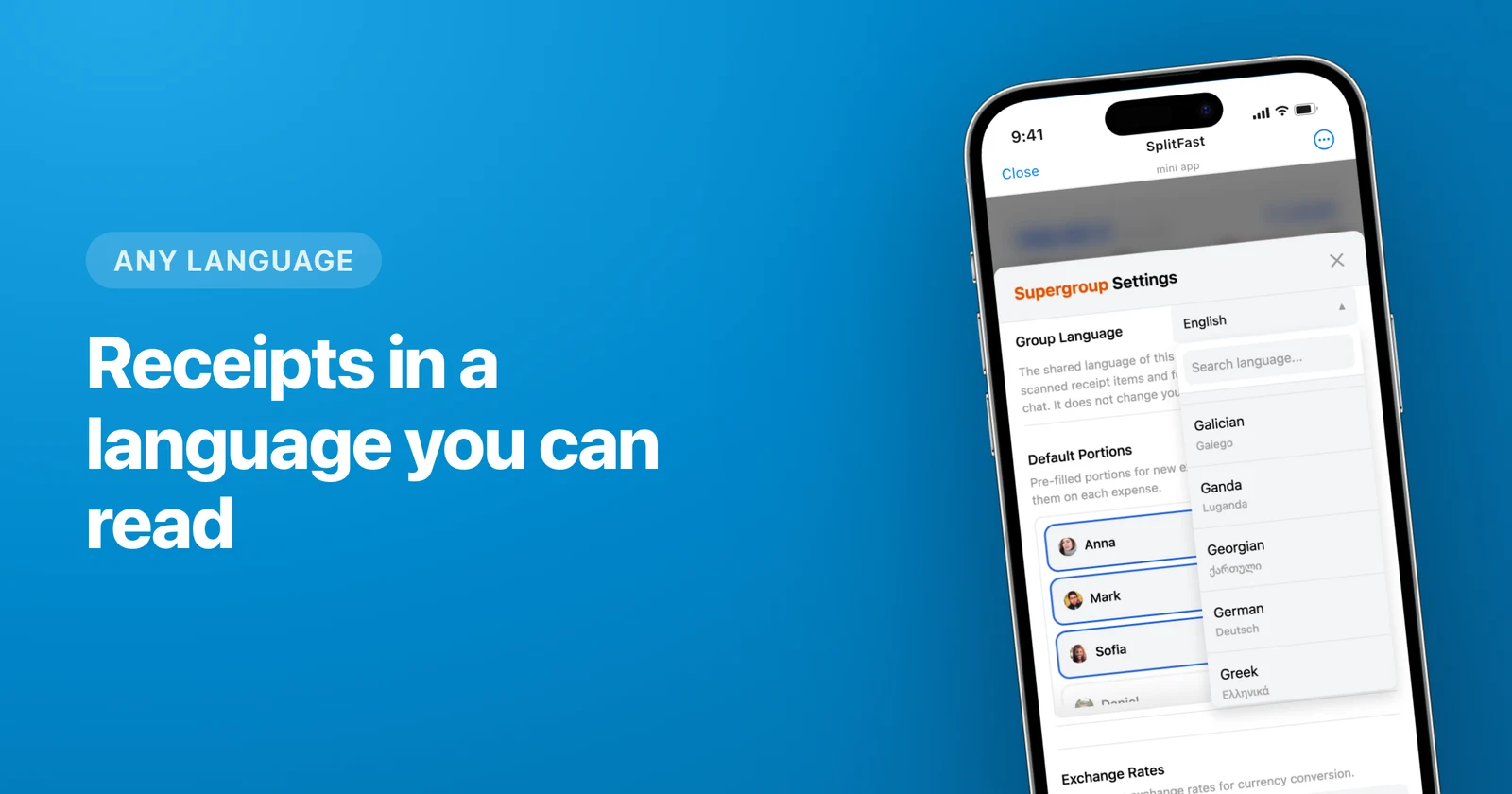
If you want to know what’s actually on the bill, you can translate it right in Telegram.
Keeping it in Telegram
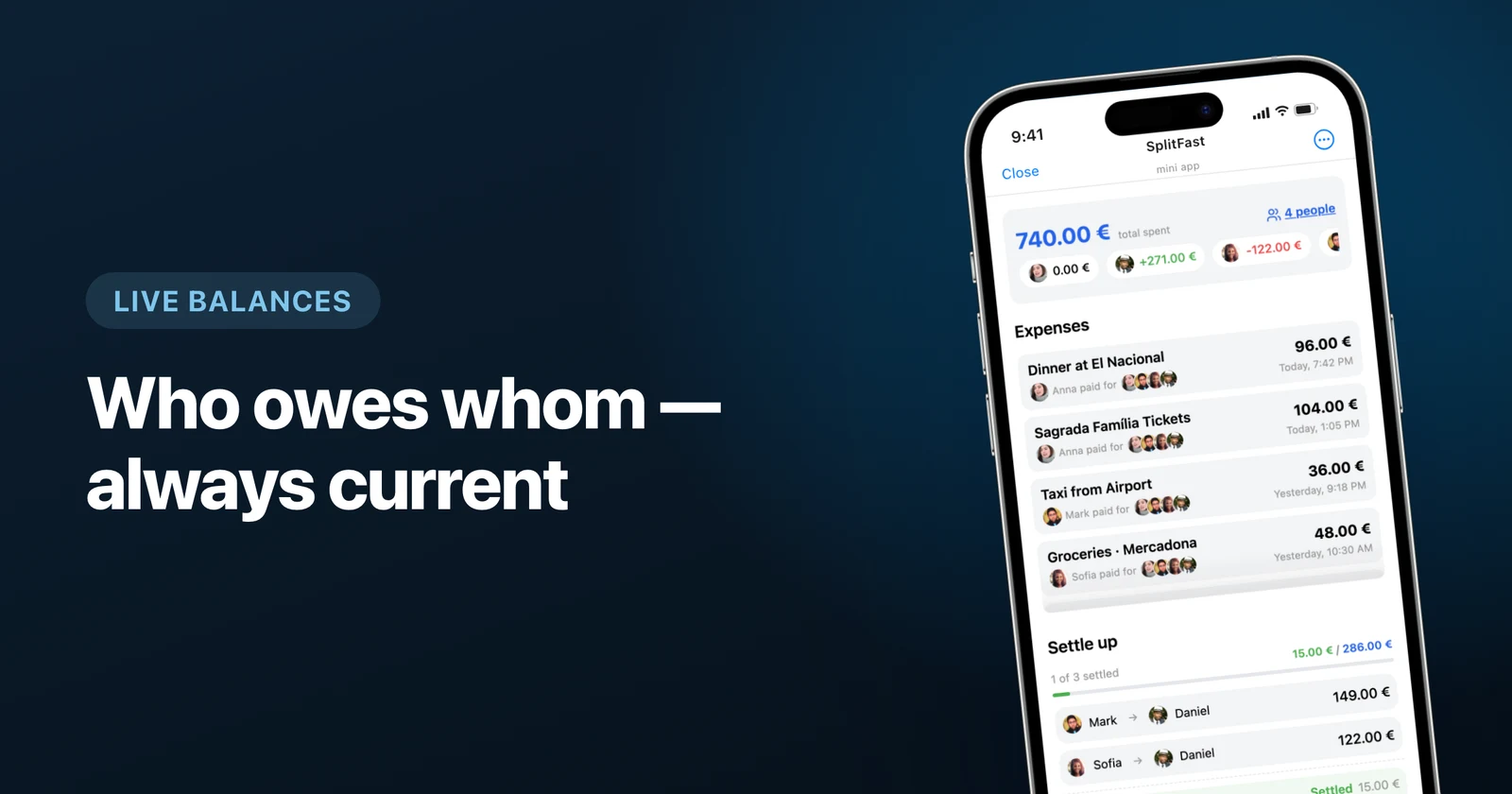
SplitFast lets you split expenses in Telegram in the trip chat itself. Add the bot to the group and set the group’s “Currency” to lari. From then on, whoever pays logs the expense in lari from the receipt, and at the end “Balances” shows the debts in lari too. When Vicky sends Hannah pounds from home, either of them taps “Mark as Settled” on the 289-lari debt.
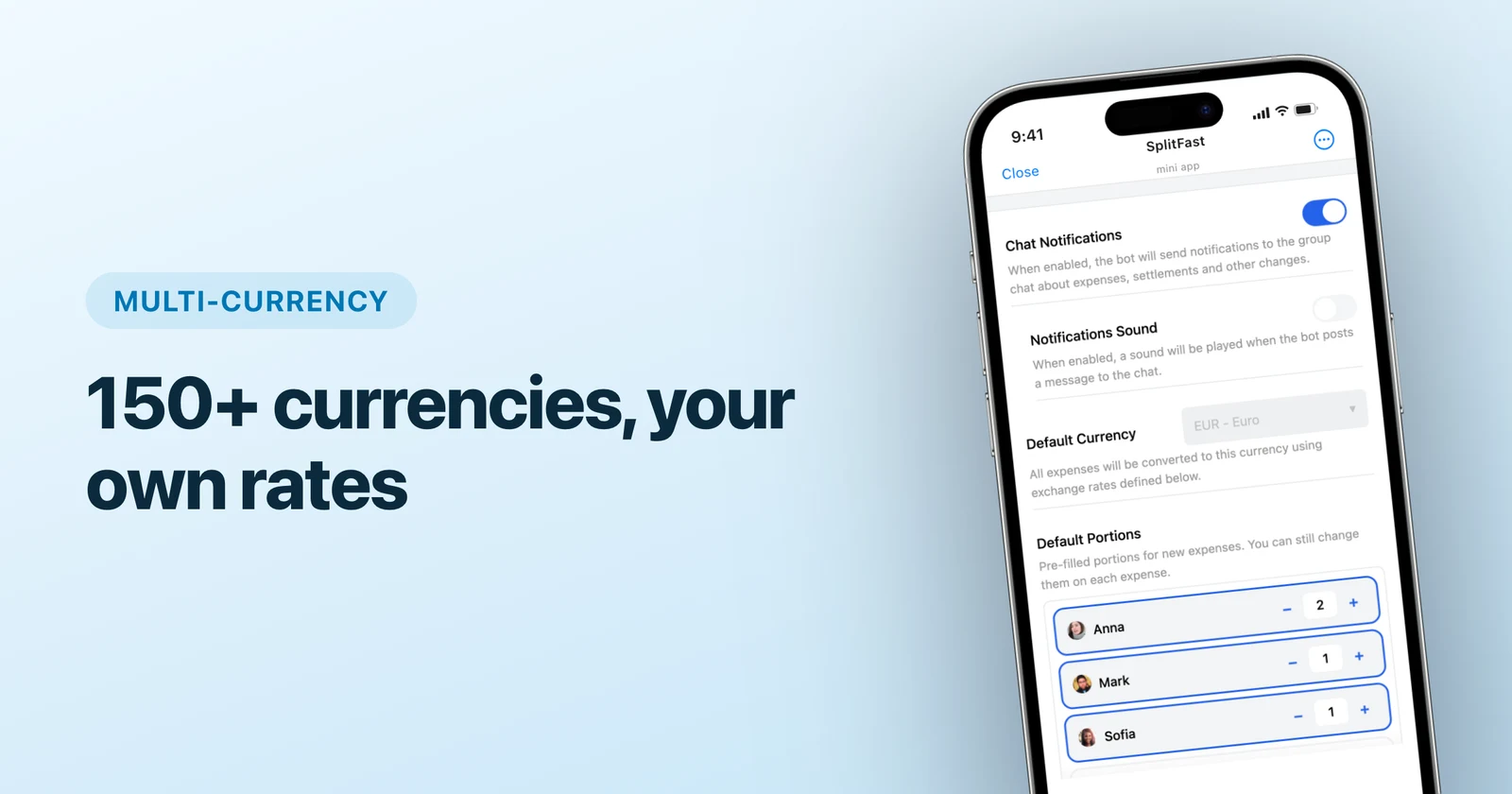
If your trip mixes lari, pounds and euros, there is a separate guide to splitting expenses in several currencies.
Checklist
- Some pounds in cash for the first few days, or dollars if you already have them.
- A card with no overseas fees, if you have one.
- Health and accident insurance with at least 30,000 lari of cover, required for entry since 1 January 2026.
- A trip group with lari as its currency, and the bot in the chat.
- An agreed rate for settling up at home.
- On the morning of the Gudauri trip, a check that the road is open.
Sources
- Official lari rates for 13.11.2026: National Bank of Georgia
- Exchange rates on 13.11.2026: Rico Credit; Liberty Bank, commercial rate
- Exchange offices, cash machines, the airport, paying in your home currency and service charges: The Georgian Guide, updated September 2026
- UK card fees abroad and choosing the local currency: MoneySavingExpert, updated 28 August 2026
- Entry without a visa for UK citizens: Government of Georgia Ordinance No. 255; GOV.UK, Georgia entry requirements
- Mandatory insurance from 1 January 2026: Ministry of Foreign Affairs of Georgia, 27.12.2025
- Public holidays: Labour Code of Georgia, Article 30
- Gudauri, the road and 2025/26 prices: The Georgian Guide, October 2026, checked to 10 November 2026; road closure: Georgia Today, 10.02.2026
- VAT in Georgia: Tax Code of Georgia, Article 166
All links checked 13 November 2026. Rates change every day, so check the current ones before you travel.
Frequently asked questions
What currency should I take to Georgia from the UK?
Pounds are fine. Tbilisi exchange offices take them at roughly 1% below the official rate: on 13 November 2026 a Rico Credit office paid 3.411 lari per pound, against the National Bank of Georgia’s 3.4431. Dollars and euros change at almost exactly the official rate, though buying them in the UK first means paying a spread twice. Skip the airport exchange desks, where rates are worse than in town.
Do UK bank cards work in Georgia?
Yes, in ATMs and card machines. Bank of Georgia charges about 3 lari per withdrawal, and TBC shows its fee on screen before you confirm. Your own bank may add a non-sterling fee on top, which MoneySavingExpert puts at around 3% on most cards. If a machine offers to charge you in pounds, decline: that rate is typically several percent worse.
How do we split costs if everyone changed money at different rates?
Log every shared expense in lari, as it was paid. The rate each person got is their own cost, like an ATM fee. Settle in lari cash before you leave, or at home in pounds at one rate agreed in advance, such as the National Bank of Georgia’s official rate on the day of the transfer.
How do you get from Tbilisi to Gudauri, and what does it cost?
A marshrutka (minibus) from Didube station costs 15 lari per person. A car with a driver starts at 196 lari for the whole car, according to prices The Georgian Guide checked on 28 October 2026, which works out at 49 lari each for four. In winter the road beyond Gudauri closes when the avalanche risk is high, so check on the morning you travel.
Do British citizens need a visa for Georgia?
No. The United Kingdom is on the Georgian government’s list of countries whose citizens can enter and stay without a visa for a full year. Since 1 January 2026, though, every tourist needs health and accident insurance with cover of at least 30,000 lari, according to Georgia’s Ministry of Foreign Affairs.