Travel
How to Split Gas Money on a Road Trip: Formula, Table and the Driver Question
Read in other languages: Русский
The easiest way to split gas money on a road trip is per car: log every fill-up on the driver and split it among the people who rode in that car. Tolls and parking work the same way. Below is a formula you can run in your head, a ready table at current U.S. prices, and the three questions that start arguments: split per car or across everyone, does the driver pay, and what about the friend who only rode one way.
Two cars, six friends, one gas bill?
New Year’s weekend, six friends heading to a cabin about 300 miles away. Mike drives his SUV with Sam and Jess. Nora drives her small sedan with Leo and Tess. Tess rides only one way. She has to be back at work on the 2nd and will take the bus home.
At the first gas station Mike says: “Let’s throw all the receipts together and divide by six.” Nora quietly works out how little her car burns compared with his. Tess asks why she should pay for a drive back she won’t be on.
A formula you can do in your head
Cost = gallons × price per gallon.
The round trip is 600 miles. Mike’s SUV gets 25 mpg, so it needs 24 gallons. The U.S. average for regular gasoline in the week of November 2, 2026 was $4.153 per gallon, according to the EIA. Mike’s car costs $99.67 there and back. Split three ways, that is $33.22 each.
The formula is for budgeting ahead of time. On the road, log the actual pump receipts. Cold weather, a roof box and traffic all push real mileage below the number on the window sticker.
Gas cost table for 100, 250 and 500 miles
Calculated at $4.153 per gallon, the EIA U.S. average for regular in the week of November 2, 2026. Rounded to the cent.
| Distance | 25 mpg | 30 mpg | 35 mpg |
|---|---|---|---|
| 100 miles | 4 gal, $16.61 | 3.3 gal, $13.84 | 2.9 gal, $11.87 |
| 250 miles | 10 gal, $41.53 | 8.3 gal, $34.61 | 7.1 gal, $29.66 |
| 500 miles | 20 gal, $83.06 | 16.7 gal, $69.22 | 14.3 gal, $59.33 |
For a round trip, double the distance. Prices vary by region: the same EIA update had the West Coast at $5.296 and the Gulf Coast at $3.636. If you know your local price, use that.
Split per car or across everyone
Nora’s sedan gets 35 mpg. The whole drive costs her car $71.19, against $99.67 for Mike’s. Here is how the two methods compare:
| Per car | All fill-ups pooled | |
|---|---|---|
| Mike, Sam, Jess (car 1) | $33.22 each | $31.07 each |
| Nora, Leo (car 2) | $28.48 each | $31.07 each |
| Tess (car 2, one way) | $14.24 | $15.53 |
In this example the gap is under three dollars a person. Both cars cover the same distance and their mileage is not wildly different. If one car burns twice as much as the other, or carries two people instead of four, the gap grows fast. Per car is fairer, pooling is simpler. Agree on one before you leave.
Does the driver pay for gas?
This is the touchy one, and there is no single answer. There are three common options:
- The driver pays a share of gas like everyone else. The car is going anyway, and so is the driver.
- The driver pays nothing for gas, and the passengers split it among themselves. That is the thank-you for driving and for the miles on the car.
- The passengers cover all the gas plus an agreed amount for wear and tear.
If you go with the third option and want a reference point for wear, the IRS business mileage rate is one. It was 72.5 cents per mile from January 1, 2026, and the IRS raised it to 76 cents from July 1, 2026, citing higher fuel prices. For Mike’s 600 miles that would be $456, more than four times his gas. The IRS bases that rate on the fixed and variable costs of running a car, which is why it dwarfs the gas. Treat it as a ceiling and agree on less.
Any of the three is fine if it was agreed before the first fill-up. Trouble starts when the driver decides at the end that he deserves more.
Tolls and parking
Tolls and parking are costs of the car, just like gas, and they go to the people in it. Tolls can be a bigger line than people expect. On the Pennsylvania Turnpike, a passenger car crossing the whole state from the Ohio line to the New Jersey line pays $62.76 with E-ZPass and $125.72 with Toll By Plate, at the rates in effect from January 4, 2026. The Turnpike itself says E-ZPass saves 50 percent.
So if one car has a transponder and the other doesn’t, the same road can cost them very different amounts. Log tolls as the driver paid them. If the transponder bill shows up on the driver’s statement weeks later, add it then as one expense for that car’s passengers.
The friend who rode one way
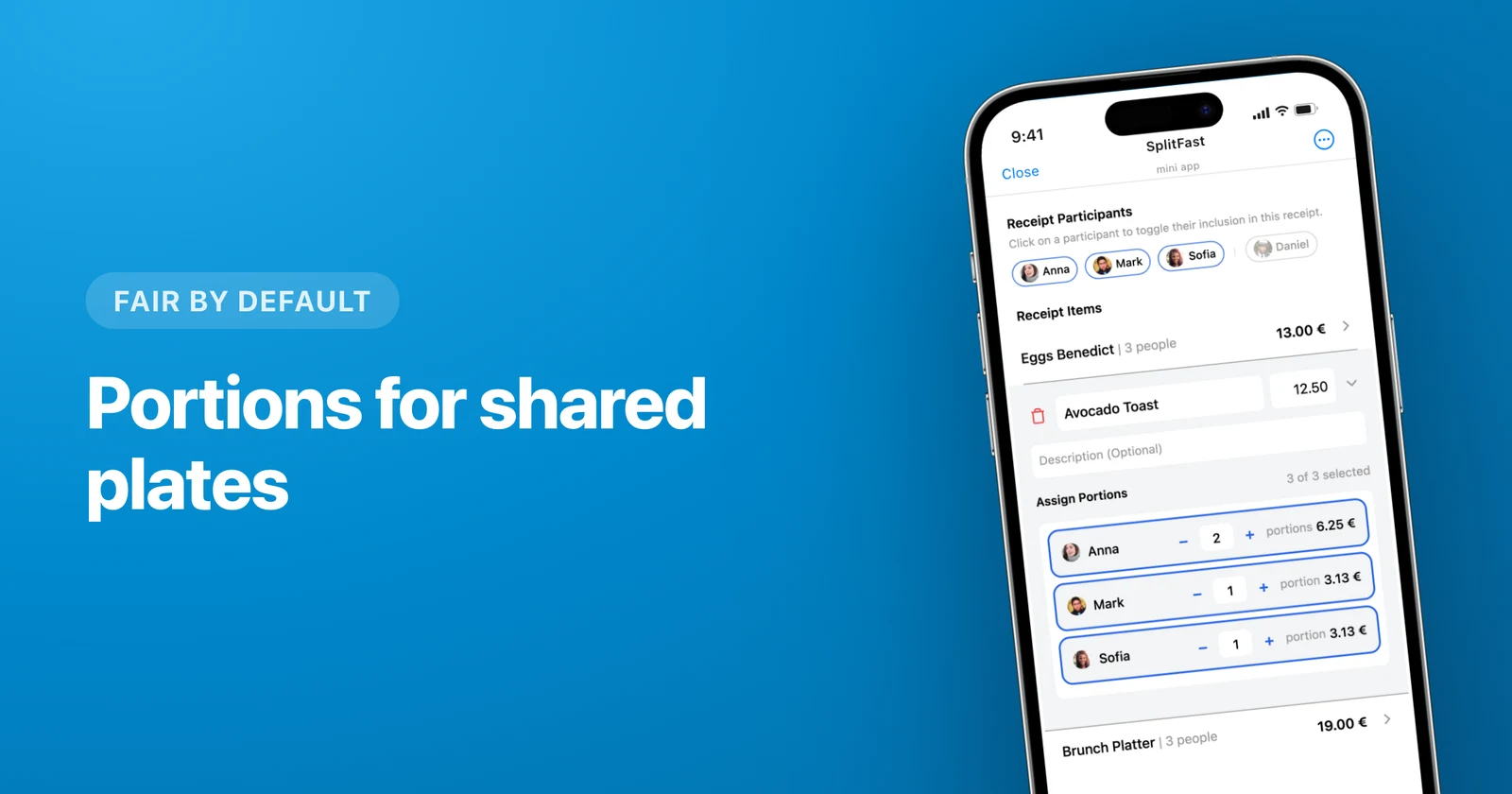
Tess rode only to the cabin, so she shouldn’t pay for the drive back. The easy fix: on car 2’s gas expenses, give Nora and Leo 2 portions each and Tess 1. Out of $71.19, Nora and Leo pay $28.48 each and Tess pays $14.24. You don’t need to log the outbound and return trips separately.
The same trick works for a cousin picked up halfway or a friend dropped off in the next town. There is more on cases like this in the guide on how to split a bill unequally.
How to track it in Telegram
Your trip already has a group chat, and SplitFast lets you split expenses in Telegram right inside it. Add the bot to the group, then:
- each driver logs every fill-up as paid by them and ticks only the people in their car;
- for a one-way rider, use the “Portions” split: 2, 2 and 1;
- log tolls and parking the same way, on that car’s passengers;
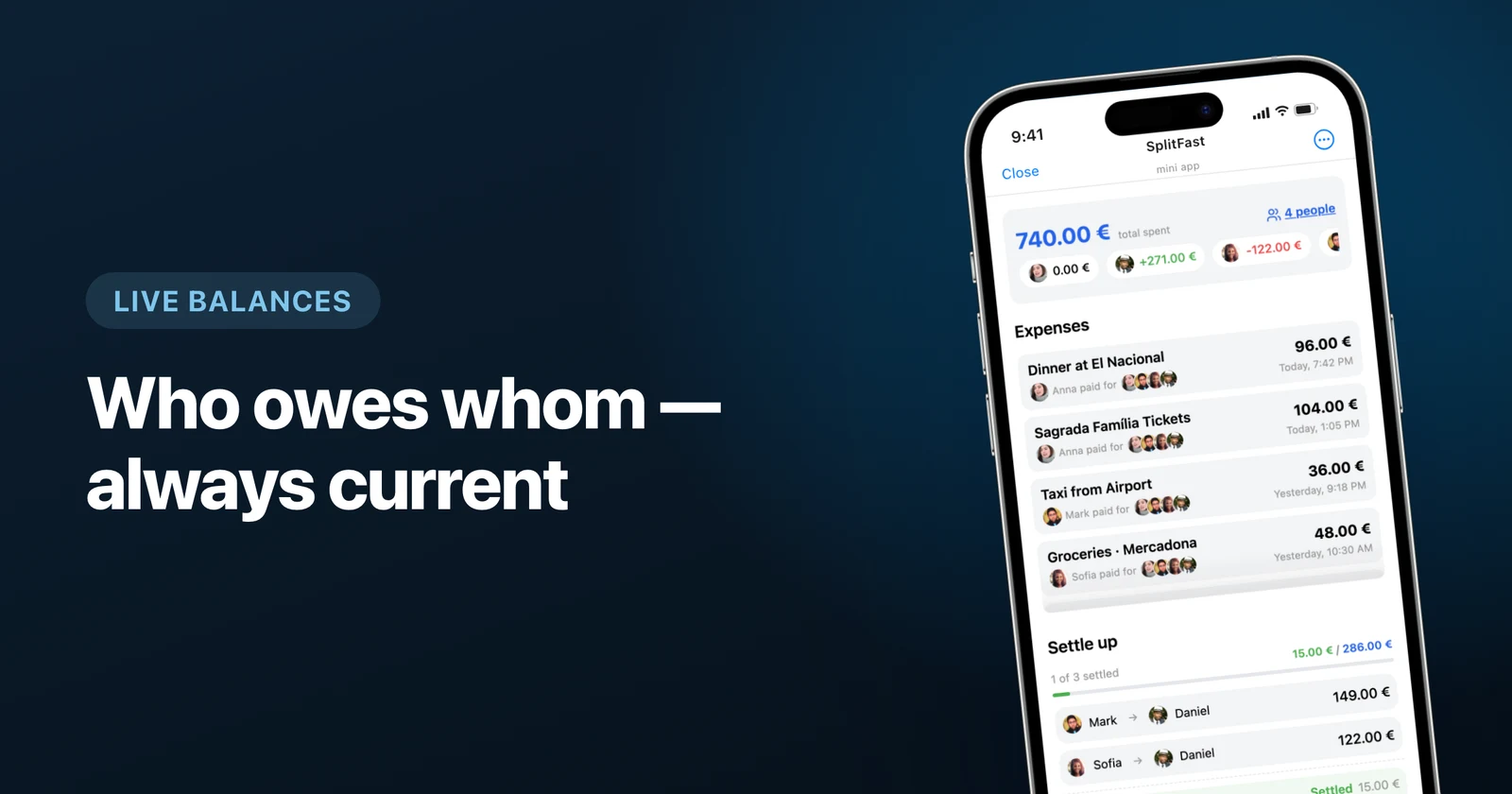
- at the end of the trip, balances show who owes whom and reduce it all to the fewest transfers.
If the drive ends at a ski resort, there is also lodging and lift passes to split. That is covered in the ski trip cost guide. When everyone is home, the guide on settling group debts covers the last step.
Sources
- U.S. regular gasoline price, week of November 2, 2026: EIA, Gasoline and Diesel Fuel Update, released November 3, 2026
- IRS business mileage rate from January 1, 2026: IRS news release IR-2025-128, December 29, 2025
- IRS business mileage rate from July 1, 2026: Internal Revenue Bulletin 2026-29, Announcement 2026-11
- Pennsylvania Turnpike tolls from January 4, 2026: 2026 Toll Calculation Guide (PDF)
All links checked November 5, 2026. Gas prices change every week; tolls usually once a year.
Frequently asked questions
How do I calculate gas money for a road trip?
Divide the distance by your car’s miles per gallon to get gallons, then multiply by the price per gallon. A 500-mile drive at 30 mpg uses about 16.7 gallons. At the U.S. average for regular in the week of November 2, 2026 ($4.153 per gallon, EIA), that is about $69.
Should the driver pay for gas?
There is no single rule. Some groups split gas evenly including the driver. Others let the driver skip gas as thanks for driving and for the miles on the car. Others pay the full gas bill plus an agreed amount for wear. Pick one before the first fill-up and say it out loud.
Should we split gas per car or across the whole group?
Per car is fairer when the cars differ a lot in mileage or in how many people ride in them. If the cars are similar and equally full, adding up all the fill-ups and splitting across everyone is simpler, and the difference is small.
Should friends use the IRS mileage rate?
It is a tax figure for business driving: 72.5 cents per mile from January 1, 2026 and 76 cents from July 1, 2026. The IRS bases it on the fixed and variable costs of running a car, so it comes out several times higher than the gas alone. Some groups use it as a ceiling when they want to pay the driver for wear.